
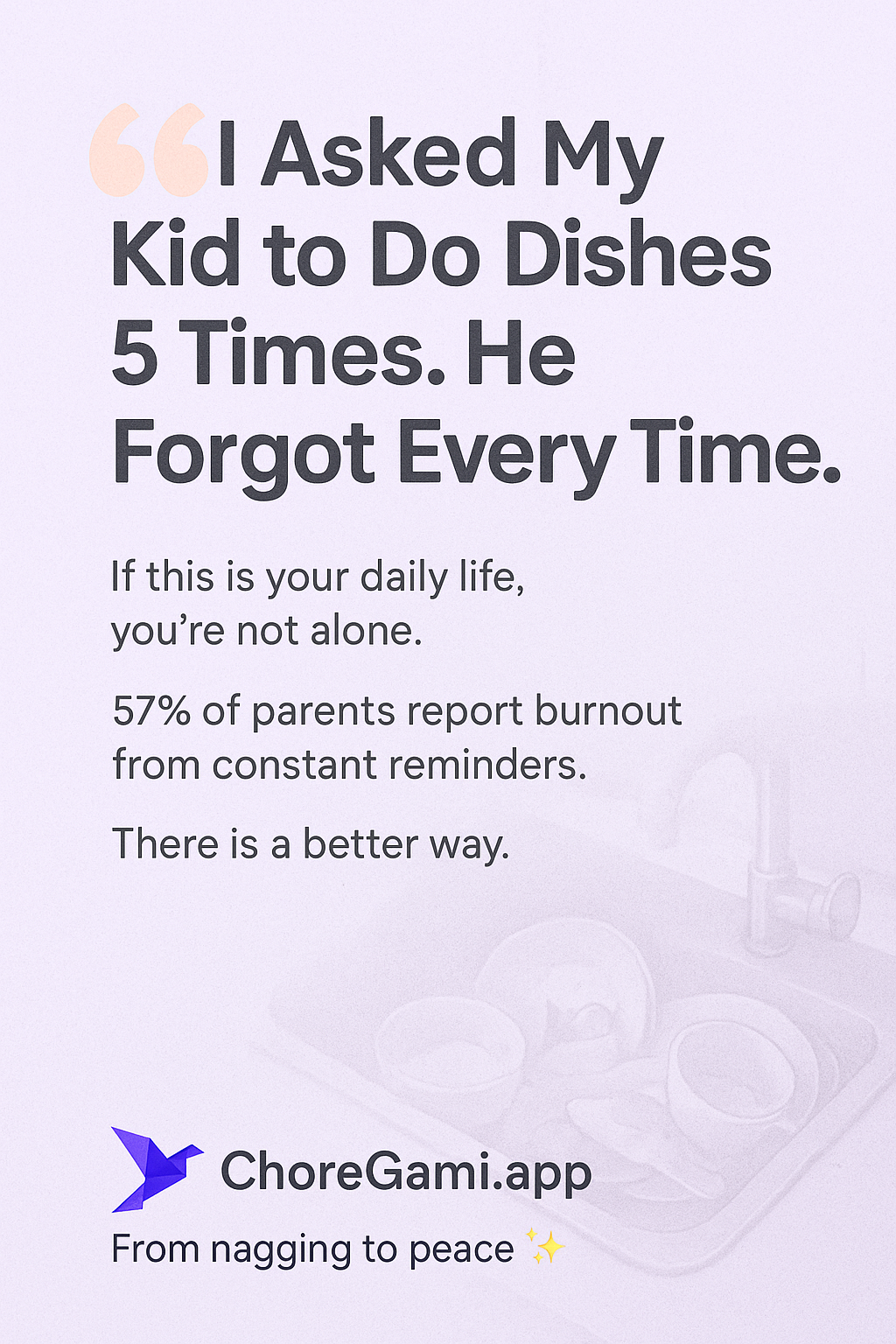
Let me set the scene.
It’s 6:47 PM. Dinner is over. The dishes are in the sink. You turn to your 10-year-old — let’s call him Toby, because that’s his name — and say the words.
“Toby, please do the dishes.”
“Okay,” he says. He does not move. He does not look at the sink. He does not acknowledge that dishes exist as a concept. He is already back on his tablet, fully absorbed in a YouTube video where someone else’s kid is — I’m not making this up — pretending to do chores in Roblox.
Let that sink in. He won’t do real dishes, but he’ll watch fake ones.
The Timeline of Forgetting
Here’s how the next 90 minutes of your life go. I know this because it’s how every evening goes. Scientists could set their clocks by it.
6:47 PM — The First Ask “Toby, dishes please.” “Okay!” Nothing happens.
7:02 PM — The Gentle Reminder “Hey bud, the dishes?” “Oh yeah! I forgot. I’ll do it right now.” He does not do it right now.
7:18 PM — The Slightly Less Gentle Reminder “Toby. Dishes. Now, please.” “I WAS ABOUT TO.” Narrator: He was not about to.
7:31 PM — The Tone Shift “Tobias.” (Full name deployment — things are serious.) “The dishes are still in the sink.” “WHY ARE YOU ALWAYS NAGGING ME?”
Ah, yes. You’re the problem. The person who cooked dinner, served dinner, cleaned up dinner, and made the radical request that one human rinse some plates — you are the villain in this story. How dare you.
7:45 PM — The Breaking Point You do the dishes yourself while making aggressive eye contact with no one in particular. Toby wanders in for a glass of water, steps over the wet floor you just mopped, and asks, “What’s for dessert?”
You consider moving to a small island where there are no dishes. Or children.
You Are Not Alone (Statistically Speaking)
If this sounds like your house, you are in enormous company.
According to a 2024 survey by the American Psychological Association, 57% of parents report burnout specifically from the repetitive cycle of reminding, nagging, and following up on household tasks. Not from the tasks themselves — from the asking.
Let that number land. More than half of parents are exhausted not by the chores but by the managing of the chores. We’ve become unpaid project managers for tiny humans who didn’t apply for the job and refuse to check their email.
Another study from Ohio State University found that the average parent gives the same household instruction 7.3 times before it’s completed. Seven point three. That’s not parenting, that’s a customer service hold queue.
The Science of “Forgetting”
Here’s the thing about Toby: he’s probably not lying. (Probably.)
When a kid says “I forgot,” there are actually three different things that might be happening:
1. Working Memory Overload
Kids — especially kids with ADHD — have limited working memory. It’s like RAM in a computer. They can hold about 3-4 things in active memory at once. So when you say “do the dishes” while they’re watching a video, here’s what their brain does:
- Slot 1: This video is cool
- Slot 2: I’m hungry again
- Slot 3: Is that a spider on the ceiling?
- Slot 4: …what did Mom say?
Your instruction didn’t even make it into the queue. It bounced off the velvet rope like a B-list celebrity at a nightclub.
2. The Intention-Action Gap
This one is actually fascinating. Your kid genuinely intends to do the dishes. In the moment they say “okay,” they mean it. The problem is that the bridge between “I should do this” and “I am doing this” is made of wet tissue paper.
Adults have this gap too — it’s why you have 14 unread books on your nightstand — but kids have a much wider canyon to cross, especially without external structure.
3. Strategic Incompetence
Okay, sometimes they’re gaming the system. If doing it badly enough or slowly enough means you eventually do it yourself… congratulations, your child has invented a management strategy that Fortune 500 executives use daily. He’s not lazy. He’s delegating upward.
Why “Just Remind Them” Doesn’t Work
“But my mom reminded me and I turned out fine!” Sure. But let’s look at what reminding actually costs:
Your energy: Each reminder costs you a tiny piece of your patience. By reminder #5, you’re not the same person you were at reminder #1. Reminder #1 was cheerful. Reminder #5 is considering boarding school.
Your relationship: Research from ImpactParents shows that repetitive reminding damages the parent-child relationship over time. Kids start associating your voice with criticism, not communication. You become the person who’s always asking them to do stuff — not the person they want to tell about their day.
Your kid’s autonomy: Every time you remind, you’re teaching them that they don’t need to remember — because you will. You’ve accidentally become their external brain. And external brains don’t build internal responsibility.
ADDitude Magazine puts it bluntly: “Children with ADHD do better with concrete, visual cues — not verbal reminders. When it’s just talk, many children interpret it as nagging.”
Translation: your words are going in one ear and out the other, and it’s not (entirely) their fault.
What Actually Works (Besides Moving to That Island)
Good news: there are things that work better than asking 7.3 times. Most of them involve shifting from verbal to visual, and from you managing to the system managing.
Make It Visual
If the chore isn’t written down somewhere the kid can see it — on a screen, on a board, on a card — it doesn’t exist. Verbal instructions are invisible. They disappear the moment they leave your mouth.
A visual task list puts the responsibility on the system, not on you. The kid checks the list, not your face. This is huge for your relationship and their independence.
Add Time Estimates
“Do the dishes” feels infinite to a kid. “Load the dishwasher (~7 minutes)” feels survivable.
Time estimates are one of the simplest and most effective changes you can make. When kids know a task has an end, they’re dramatically more likely to start it. “7 minutes” is less than one YouTube video. Suddenly it’s not so scary.
Use Points, Not Pressure
What if doing the dishes earned your kid 15 points toward something they actually want? Now the motivation isn’t “Mom told me to” — it’s “I want to hit 100 points by Friday.”
That’s a fundamentally different relationship with the chore. The parent stops being the enforcer. The system becomes the motivator. And the kid starts making choices instead of obeying orders.
Rotate So It’s Fair
“Why do I ALWAYS have to do the dishes?” “You don’t. You have dishes this week. Next week it’s your sister’s turn. The week after, it’s Dad’s. It’s on the rotation.”
Conversation over. No arguments. No negotiations. The rotation is the rotation. It’s not personal — it’s just how the system works.
The Dream Scenario
Imagine this instead of the 6:47 PM nightmare:
Toby finishes dinner. He opens the app on his tablet — the same tablet he was ignoring you from earlier. He sees: “Load dishwasher — 7 min — 15 points.” He also sees his streak is at Day 9, and if he hits Day 10, he gets to choose the family movie this weekend.
He does the dishes. Without being asked. Without being reminded. Without you saying a single word.
You’re sitting on the couch reading a book. An actual book. For pleasure. Like a person.
Is this a fantasy? Kind of. But it’s also what happens when you replace verbal reminding with a system that speaks your kid’s language: points, streaks, visual checklists, and real motivation.
Three Things You Can Do Tonight
No app required. No purchases. Just start here:
Write the evening chores on a whiteboard or paper and stick it where your kid can see it. Don’t tell them — show them. When they ask “what do I have to do?” just point at the board.
Add a time estimate next to each chore. “Clear table ~3 min. Load dishwasher ~7 min. Wipe counters ~4 min.” Watch how much less resistance you get.
Stop reminding after the first ask. Seriously. Tell them once, point to the list, and walk away. The hardest part is not filling the silence with another reminder. Let the system do the work.
When You’re Ready to Stop Being the Reminder
If you want a system that handles the visual checklists, points, streaks, and rotation automatically — so “did you do the dishes?” stops being your catchphrase — that’s what ChoreGami was built for.
It was designed by a parent who was tired of being a human alarm clock. One who’d rather spend the evening reading a book than saying “dishes” for the fifth time.
Try it free for 15 days. No credit card. No nagging required.
Sources
- ADDitude Magazine: Getting Your ADHD Child to Listen Without Nagging
- ImpactParents: Why Nagging Doesn’t Work, Especially for Kids with ADHD
- PeaceHealth: ADHD: Helping Your Child Get Things Done
- American Psychological Association: Parenting Burnout and Household Labor
Dedicated to Toby. And every Toby. You know who you are. You still haven’t done the dishes.
Comments (0)
Be the first to leave a comment!
Leave a Comment